

What Happens After You Place a Bulk Textile Order?


The Real Manufacturing Process Explained in Simple Terms for Hospital and Hotel Buyers
If you are ordering bed sheets, duvets, pillows, towels, or mattress protectors in bulk, you have probably asked yourself:
- Why does production take several weeks?
- Why do prices vary between manufacturers?
- Where exactly does the money go?
Many bulk buyers focus only on the unit price. However, behind every hospital or hotel linen order, there is a structured manufacturing process that directly affects your cost, delivery timeline and long-term durability.
At Sana Fashion Fusion, we manufacture hospital and hospitality linens at scale. In this guide, we explained what actually happens after you place a bulk textile order so you can calculate your budget properly and avoid unexpected surprises.
This article is particularly helpful for:
- Hospital procurement teams
- Hotel purchasing managers
- Care home operators
- Wholesalers and distributors
- Small traders entering institutional supply
Step 1: Confirming the Exact Specifications (Getting the Details Right First Time)
Production does not begin with stitching. It begins with clarification.
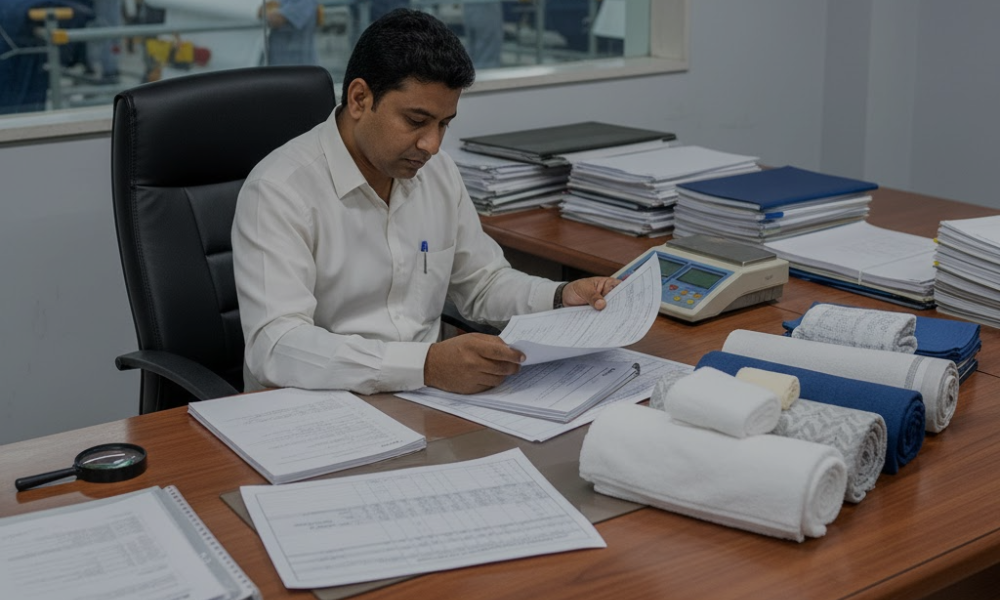
Before we purchase fabric or allocate production time, we finalise every technical detail of your order. This includes:
- Exact bed sheet dimensions
- Fabric type (100% cotton, poly-cotton blend, microfiber)
- GSM (fabric weight and thickness)
- Thread count
- Elastic depth for fitted sheets
- Logo embroidery or labelling
- Packaging requirements
For hospitals, accuracy is extremely important. Even a small mistake in mattress depth can result in sheets that do not fit properly. If you are unsure about correct dimensions, our detailed hospital bed sheet sizes buying guide explains how to measure correctly and avoid costly errors.
Why this stage matters for your budget:
- Heavier fabric (higher GSM) costs more
- Larger or custom sizes use more fabric
- Branding and embroidery increase labour time
- Special packaging adds to logistics cost
Once specifications are approved, your order moves into production planning.
Step 2: Purchasing the Raw Materials (Where Most of the Cost Comes From)
The largest portion of your budget often 50 to 65 percent goes towards raw materials.
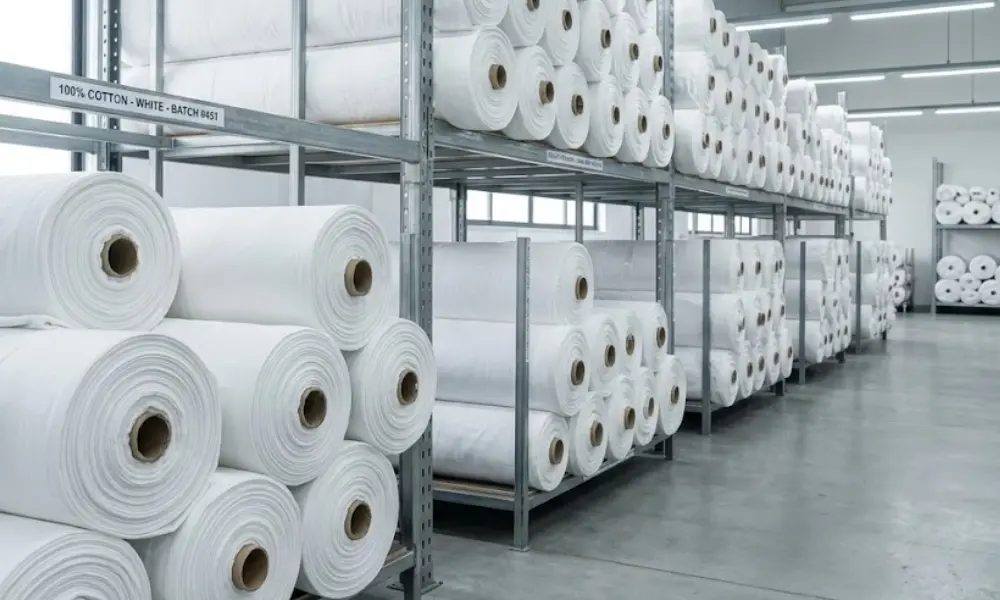
This includes:
- Fabric rolls
- Filling material for duvets and pillows
- Elastic bands and zips
- Waterproof layers for mattress protectors
- Sewing threads and accessories
For hospital linens, fabrics must withstand frequent high-temperature washing. They may also require antibacterial treatments.
For hospitality clients, comfort and appearance are often prioritised. Higher thread count cotton and premium finishes are common choices.
If you are comparing materials for comfort and durability, our silk vs cotton vs bamboo sheets guide explains the differences clearly for commercial buyers.
Choosing cheaper fabric may reduce your initial invoice. However, lower-grade material often shrinks, fades or wears out faster, meaning higher replacement costs later.
Step 3: Cutting the Fabric (Reducing Waste and Controlling Costs)
Once materials arrive, they are inspected and moved to the cutting department.
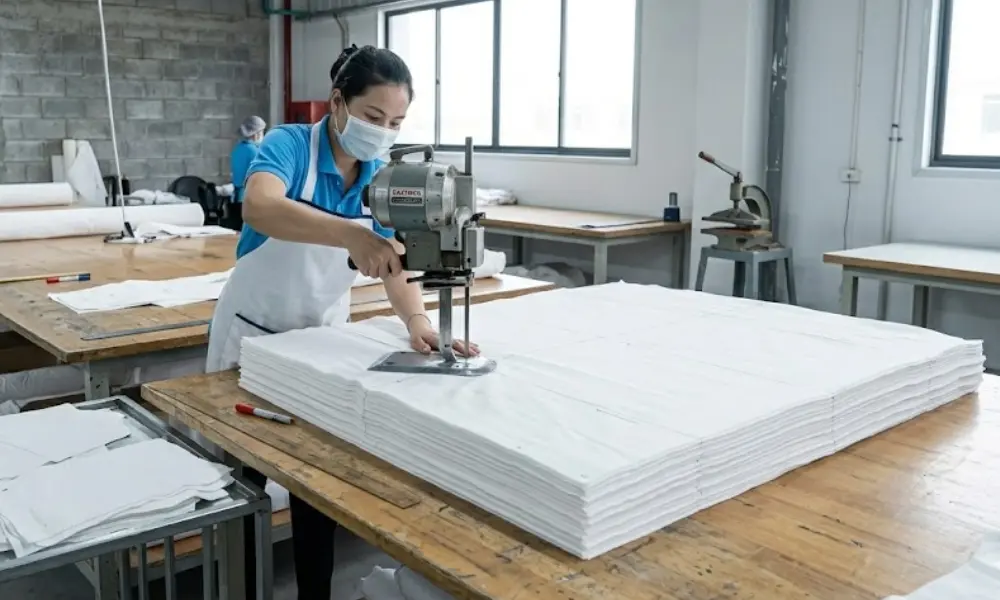
Fabric is stacked in layers and cut using industrial machines. Before cutting begins, specialists create a “marker plan” to position each pattern piece carefully. This reduces fabric wastage.
Fabric wastage typically ranges between 3 and 8 percent. Efficient planning protects your budget.
If cutting is poorly managed, the result can be:
- Inconsistent sizes
- Fabric waste
- Higher production cost
This stage may not be visible to buyers, but it significantly influences pricing.
Step 4: Stitching and Assembly (Skilled Labour at Work)
After cutting, the pieces move to the stitching lines.
Depending on the product, processes may include the following:
- Straight stitching
- Overlocking edges
- Adding elastic to fitted sheets
- Quilting duvets and mattress protectors
- Reinforcing corners
Labour cost depends on:
- Product complexity
- Stitch density
- Order size
- Delivery deadline
If you require urgent production, additional labour shifts may be needed. This increases cost.
To better understand what quality stitching looks like, our article on how to evaluate textile quality explains practical checks buyers should make before confirming large orders.
Step 5: Quality Control (Protecting Your Investment)
Quality control is not a single inspection at the end. It happens throughout production.

Professional manufacturers use three main stages:
- Inline checks during stitching
- Mid-production inspection
- Final inspection before packing
For hospitals, checks focus on:
- Shrinkage resistance
- Seam strength
- Colour fastness
- Wash durability
For hotels, appearance is equally important. Sheets must look uniform, smooth and premium.
If you are selecting a new supplier, our guide on how to choose a textile supplier for bulk orders outlines the key factors you should review beyond price alone.
Skipping proper quality checks may reduce short-term costs, but it increases the risk of returns and complaints. We use these quality check processes.
Step 6: Washing, Finishing and Pressing (Improving Durability and Presentation)
Before dispatch, products go through finishing processes such as:
- Pre-shrinking
- Softening
- Steam pressing
- Final thread trimming
Pre-shrinking is particularly important for hospital environments where high-temperature laundering is common.
Finishing usually adds around 5 to 10 percent to production cost. However, it improves durability and reduces shrinkage issues.
For hospitality buyers, finishing also enhances guest experience by ensuring a soft, polished appearance.
Step 7: Packaging and Shipping (The Final Stage)
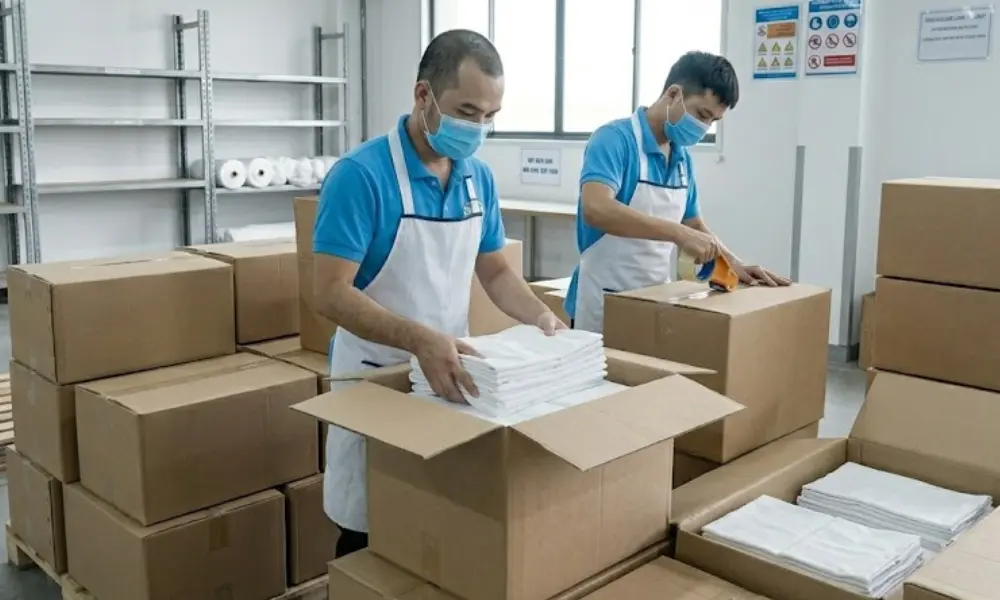
Once approved, items are:
- Folded and packed
- Placed in polybags or bulk cartons
- Labelled and barcoded
- Palletised for transport
Shipping cost depends on:
- Total weight
- Carton volume
- Destination
- Delivery urgency
For international shipments, export documentation must also be arranged.
These costs should always be included in your procurement calculations.
Typical Production Timeline for Bulk Linen Orders
| Stage | Estimated Time |
| Specification Approval | 2-4 days |
| Raw Material Procurement | 5-10 days |
| Cutting and Stitching | 10-20 days |
| Quality Control and Finishing | 5-7 days |
| Packaging and Dispatch | 3-5 days |
Total average production time: 20 to 40 days depending on order size and complexity.
How to Calculate a Safe and Realistic Budget
When budgeting, avoid focusing only on the quoted unit price.
A safer calculation includes:
- Fabric cost
- Labour cost
- Finishing cost
- Packaging cost
- Freight cost
- 5 to 8 percent contingency buffer
Basic formula:
Estimated Budget = (Unit Cost × Quantity) + Logistics + 5-8% Buffer
If you are unsure how order size affects cost efficiency, our guide on MOQ vs cost: how to optimise your budget explains how minimum order quantities influence pricing.
For a broader understanding of procurement planning, our hospital and hospitality linens guide for bulk buyers provides additional insights.
Common Mistakes Bulk Buyers Make
Many buyers unintentionally increase costs by:
- Ignoring fabric GSM
- Ordering incorrect sizes
- Choosing the cheapest supplier without evaluating quality
- Over-customising small quantities
- Underestimating lead times
Smaller traders entering the market often face strong competition. Our article on how small traders compete in the market explains how smart procurement decisions improve margins.
Why Transparency in Manufacturing Matters
Understanding the real manufacturing process allows you to:
- Forecast budgets accurately
- Negotiate more effectively
- Reduce procurement risks
- Improve long-term cost control
Price differences between manufacturers usually reflect differences in:
- Fabric quality
- Labour standards
- Quality control systems
- Operational efficiency
The lowest quote is not always the most economical choice over time.
Frequently Asked Questions
How long does bulk linen manufacturing usually take?
Most bulk textile orders take between 20 and 40 days depending on fabric availability, order volume and customisation requirements.
What is the biggest cost factor in bulk textile production?
Raw material particularly fabric is the largest cost component, often accounting for more than half of the total production cost.
How can I reduce my bulk order costs safely?
Standardise sizes, confirm specifications early, optimise order quantities and allow sufficient production time to avoid rush fees.
Are hospital linens different from hotel linens?
Yes. Hospital linens focus on durability and hygiene, while hotel linens prioritise comfort and visual appeal.
What contingency buffer should I keep in my budget?
A buffer of 5 to 8 percent is generally advisable to cover material price changes or freight adjustments.
Final Advice for Bulk Buyers
Placing a bulk textile order is a structured manufacturing process, not just a purchase.
When you understand how your linens are made, you can:
- Plan budgets more accurately
- Reduce unexpected costs
- Select suppliers with confidence
- Protect your institution’s standards
If you are preparing your next hospital or hospitality linen order and would like a transparent cost breakdown, our team at Sana Fashion Fusion can provide a detailed quotation tailored to your requirements.